Feb 132026
 
DPAC Logo with text underneath "Disabled People Against Cuts" and then web address dpac.uk.net
Ahead of the Senedd elections, you are invited to this hybrid joint conference and discussion organised by Unite Community Wales and Disabled People Against Cuts Cymru (DPAC Cymru).


Saturday 21st February 2026, 11am to 3pm

Hybrid at the Unite the Union Office, 1 Cathedral Road, Cardiff, CF11 9SD, or online via Teams.

Please register in advance here

Note: if attending via Teams, please put this under Access Requirements.

This is a free event; you don’t have to pay anything to attend.

You don’t have to be a member of DPAC or of Unite to attend.


Unite Community is a section of the trade union Unite for anyone not in paid employment.

A logo with rainbow-coloured people linking arms. It was Wales Unite Community Membership Cymru.


DPAC Cymru is the Welsh section of Disabled People Against Cuts (DPAC)
Disabled People Against Cuts Cymru logo.
Dec 052025
 
DPAC Logo with text underneath "Disabled People Against Cuts" and then web address dpac.uk.net

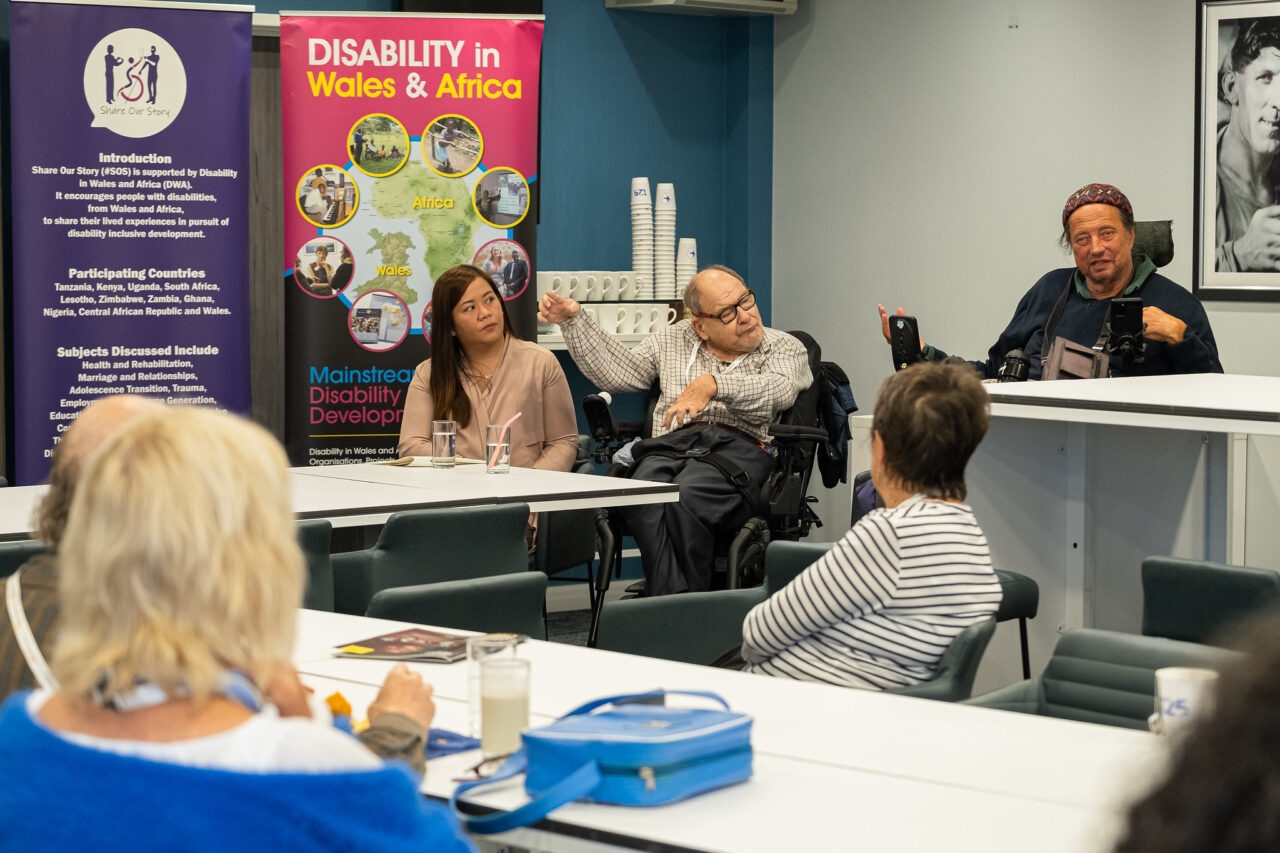
A photo of five people talking to each other indoors. Two of the people are wheelchair users. In the background is a banner that has the title "disability in Wales and Africa"

When? 10th December 2025, 11am – 1pm GMT

Where? Online via Zoom – register here

Share Our Story (#SOS) is an initiative that is emerging from the Wales Africa Movement and seeks to bring people with disabilities together and discuss their lived experiences. Since its beginning in March 2022, #SOS has shared over 200 stories and discussions with contributors from 11 African countries plus Wales.

With the assistance of Hub Cymru Africa (HCA), this online event will feature a number of presentations, plus an open panel discussion highlighting the achievements, ambitions, and lived experiences of disabled communities in Wales and Africa.


Panelists

David Achuroa is the chair of the panel. He comes from Ghana but now lives in Canada.

Luvuyo Zondani is from South Africa. He will talk about how disabled people had to challenge the local authorities in the courts to get their Dial a Ride service reinstated.

Rael Muli is a member of the local deaf community in Meru, Kenya. They hosted a local Deaf Awareness campaign.

Disabled People Against Cuts Cymru (Wales), represented by Ben Golightly and Lee Ellery. They are a group of disabled people who have come together to fight against the cuts to services and expenditure supporting disabled people in Wales and the UK. The topic they have chosen is “Nothing about us, without us!” How disabled people in Wales are demanding to be heard.


All welcome

You are invited to join us, whether you regard yourself as disabled or not. Come and learn something of what the disabled community has been doing in Wales and Africa. To register your ticket, and identify any access needs you have, please register here.

For questions or further information regarding the event or about Share Our Story (#SOS), send an email to shareourstoryinfo@gmail.com

Share Our Story, Hub Cymru Africa, and Disabled People Against Cuts Cymru logos

Click here for the full agenda


Nov 182025
 
DPAC Logo with text underneath "Disabled People Against Cuts" and then web address dpac.uk.net

This is a launch pilot of “Work without barriers” run by Reeves Disability Consultancy.

It is a free photoshoot to highlight the barriers disabled people face when accessing work.

Reeves is also developing a library to loan equipment for people struggling with the Access to Work failures and delays and lack of equipment.

20 Nov 2025, 1.30pm

Full accessible, free, pan-disability.

Professional portraits and disability pride shots.

Tramshed Tech, Unit D Pendyris Street, Cardiff, CF11 6BH.

Email joshua@reevesdisability.com

Link : https://www.eventbrite.com/e/rdcs-inclusive-disability-photoshoot-cardiff-tickets-1838694407469


This is a leaflet with a purple and orange background and a vector graphic of a camera on a tripod. At the top is the logo for Reeves Disability Consultancy. The leaflet is for an inclusive disability photoshoot in Cardif on 20 November 2025, 1.30pm. It is fully accessible, free, and pan-disability. The location is Tramshed Tech, Unit D, Pendyris Street, Cardiff, CF11 6BH

What to expect: Professional portraits, disability pride shots, creative or business focused looks.


Nov 142025
 
DPAC Logo with text underneath "Disabled People Against Cuts" and then web address dpac.uk.net
A graphic with a hot pink background and white text. In the background is a large pop-art style dark pink word that says "free". Over the image are the words: "Palestine film festival. West Norwood. Wednesday 19th November 2025, 7pm. Off the cuff, Herne Hill, SE24 0JN"

A selection of short films from Gaza, focusing on the impact of the genocide on Disabled Palestinians.

‘Palestine & Disability’ is part of the Palestinian Free Film Festival, the event will be closing out our festival.

You can read more about the festival here

The event will take place at the accessible venue Off the Cuff in Herne Hill (London) on 19th November, and we will be raising money for Palestinian groups, as well as paying to run this and future events.

The event is a completely free shorts film night documenting the experiences of Disabled people in Palestine, featuring three films and Q and A.

You can read more about the event/films here as well as how to get tickets here.

We are extremely excited that Q&A following the films will be led by DPAC’s very own Ellen Clifford. We feel very honoured to have her at the event.

We are really keen that Disabled people, and those involved in the disability rights movement hear the stories in these films, and are able to partake in this event and this conversation.

We are grateful for any feedback in how we can create as an inclusive space as possible.

We will shortly be promoting the event on our instagram after our second to film night.

In Solidarity,

Thomas (WN4P)

A logo that says "West Norwood for Palestine" using the number four instead of the word. The logo has an image of a watermelon slice in red and green.
Sep 122025
 
DPAC Logo with text underneath "Disabled People Against Cuts" and then web address dpac.uk.net

A diverse group of people are photographed holding artistic signs about disability outside of where they live.

Visit the 2025 Shape Open exhibition: Rights Cuts Action!

The Shape Open is back for its twelfth consecutive year with Rights Cuts Action: the creativity of disabled resistance, placing the work of contemporary artists in conversation with archival photography from Keith Armstrong, disabled activist, artist, and writer. The exhibition is set against a backdrop of ongoing cuts to benefits and vital support systems and the continual fight to protect disability rights.

Exhibiting artists: Emma Bentley Fox, Anna Berry, Elora Kadir, Fae Kilburn, Vince Laws, Zoe Milner, Guy Morris, Déa Neile-Hopton, Kristin Rawcliffe, Ivan Riches, Benedict Robinson, and Kim Waine-Thomas.


Where and when?

Rights Cuts Action will be open to the public at the Engine Shed, Station Approach, Crendon Street, High Wycombe, HP13 6NE, from 6 October – 5 November 2025.


Accessibility

The venue is step-free and there are accessible toilets on site. The nearest transport link is High Wycombe train station, less than a minute away.

The exhibition will be audio described and all information about the artworks will be available in audio and BSL. A Braille guide will be available on-site, as well as an Easy Read guide to the show.

If you have any questions about accessibility at the exhibition, please get in touch.


For more info see Rights Cuts Action


The Emergent project

Emergent is a project aimed at addressing and tackling the entrenched marginalisation and under-representation of disabled people in the arts sector and wider society. The main focus is creatives at an early stage in their career (including re-emerging artists) who need support in order to continue.

For more info see Emergent 2025

Sep 062025
 
DPAC Logo with text underneath "Disabled People Against Cuts" and then web address dpac.uk.net

Trade unionists look after people at work and in the community. There are 1.4 million disabled trade unionists. There is a big trade union meeting starting Sunday and ending Wednesday called the TUC (Trades Union Congress)

That meeting is discussing lots of different things (motions) and voting on them. If you are a member of a trade union you might know someone who is going, called your delegate. You might want to talk to them about the following:


Sunday 7th, 1pm

National Shop Stewards Network lobby – The Old Ship Hotel, Brighton, BN1 1NR.

One of the speakers is from Disabled People Against Cuts and the lobby is asking the TUC to support disability motions. More info.


Tuesday 9th (scheduled late morning)

Motion 38 – Disabled workers oppose welfare reforms

from the

TUC Disabled Workers Conference


Tuesday 9th (scheduled late morning)

Motion 39 – Oppose disability benefits cuts emergency

from the

TUC Trades Councils Conference


See what’s being discussed

https://www.tuc.org.uk/Congress2025/programme-business-congress-2025


Watch live or recorded sessions

https://www.tuc.org.uk/Congress2025/congress-live

Jun 252025
 
DPAC Logo with text underneath "Disabled People Against Cuts" and then web address dpac.uk.net

From Transform:

As part of our focus on developing community groups that will be ready to join a mass party of the left, Transform comrades in Leicester along with allies on the left are hosting a citizens assembly. If you are in Leicester or Leicestershire, please register and come along. Your voice matters.

We need a people-powered politics that can win real, lasting, transformative change in our communities.

Whether you’re a lifelong activist or just beginning to find your voice, this event is for you.

We’ll listen, learn, and organise together – for a future built by and for the people.

Shockat Adam and Claudia Webb have agreed to speak at the event – don’t miss it. Be part of the Leicester Assembly of Resistance. Use the link below to register.

Register here

If you can’t make it on the day, or are not from Leicester or Leicestershire, you can still help make this event a success by sharing the details of this event with any comrades or residents you know may be interested.

For those of you who would like to do something similar in your area, please either contact Anwarul at organiser@transformpolitics.uk or click on the link below to complete the form:

Community Action Form


Alt text not supplied by Transform

Image alt text not supplied by Transform.


Jun 222025
 
DPAC Logo with text underneath "Disabled People Against Cuts" and then web address dpac.uk.net

There are two upcoming events in Oxford.

  1. Oxford We Demand Change – People’s Question Time 2pm Sunday 29th June Rose Hill Community Centre
  2. Oxford DPAC Launch Meeting – 7pm Wednesday 2nd July online

Oxford We Demand Change

Oxford People’s Question Time: How can we turn the tide on despair?

  • Sunday 29 June ⏰2 – 4pm
  • Rose Hill Community Centre, Carole’s Way, OX4 4HF
  • Book tickets via eventbrite bit.ly/OxfordPQT (free)

Speaker panel

Andrew Feinstein – Anti Apartheid campaigner
Sophia Kleanthous – Disabled People Against Cuts
Lewis Nielsen – We Demand Change
Jabu Nala Hartley – Oxford Community Socialists
Ahmed Murad – Oxford Palestine Solidarity Campaign
Keir Starmer’s government has disappointed so many of us. Instead of bringing change it has brought in more attacks on working class people – from removing the fuel poverty payment to the benefit cut.
And all of this has been done hand in hand with loyal support for Israeli genocide and the racist scapegoating of migrants and refugees. The combination of austerity and racism is paving the way for Nigel Farage and far right Reform UK.
But it doesn’t have to be this way. Millions have taken to the streets for Palestine. We came out in our thousands when far right riots took to the streets. And massive numbers of people want a genuine left alternative to Starmer’s continuation of Tory policies.
How can the left turn the tide? Join this People’s Question time to ask questions to the panel, take part in the debate and discuss how we can build a movement of hope
This event is supported by: Oxford Stand Up To Racism, Strike Map, Disabled People Against Cuts (DPAC), Strike Map, Oxford Palestine Solidarity Campaign, Oxford Stop the War Coalition, Oxford & District Trades Council, DWP PCS Oxon and Bucks, South Central Postal CWU, Oxfordshire Unison Health with more support expected. https://wedemandchange.uk/


Oxford DPAC Launch Meeting

Oxford Trades Council is supporting the formation of a new Disabled People Against Cuts (DPAC) group in Oxford to fight the brutal cuts to disabled people’s benefits and services.

*Our first meeting will be on 2 July at 7:00pm*.

For more info, suggestions, etc please email oxforddpac@gmail.com.
A graphic advertising a meeting.

With a pink background and white text, it says "We Demand Change".

With a white background and blue text, and a large question mark on a pink multi-pointed star, it says, in large letters: "How can the left turn the tide?" and "Oxford People's question time".

In smaller text, it says: "Sunday 29 June 2pm, Rose Hill Community Centre, OX4 4HF".

With a pink background and white text, it has a list of names:

Andrew Feinstein, campaigner 
Sophia Kleanthous, DPAC
Ahmed Murad - Oxford Palestine Solidarity
Lewis Nielsen - We Demand Change
Jabu Nala Hartley - Oxford Community Socialists

With a white background, there are multiple organlisation logos. They are Stand Up to Racism, the Disabled People Against Cuts logo, the Stop the War Coalition logo, a logo that says PSC, a logo that says Strike Map, the PCS union logo, the CWU union logo, the UNISON union logo, and a logo that is a black circle with a yellow center and has a red cow and a red flag on it.


Feb 142018
 
DPAC Logo with text underneath "Disabled People Against Cuts" and then web address dpac.uk.net

No More Deaths on our Streets supported by DPAC

https://www.facebook.com/events/166541107460209/


March 3rd 3-6 pm

We will gather outside Downing Street to say enough is enough..
#NoMoreDeathsOnOurStreets.

Lets get together & organise how we can prevent any further needless deaths.

Today another rough sleeper died on the cold London streets just yards from Parliament.
https://www.mirror.co.uk/news/politics/homeless-man-dies-outside-parliament-12023659

Please bring along sleeping bags & other essential supplies that will keep people alive & we will also distribute these that day to those that may need them across London.

Bring noise, banners, smiles, anger & your friends.

This is a simple call out that needs more supporters asap so please add your group if you are part of one.

We MUST work together to stop this shit.

#SolidarityNotCharity


 Posted by at 19:27
Oct 132017
 
DPAC Logo with text underneath "Disabled People Against Cuts" and then web address dpac.uk.net

National Disabled People’s Summit

Saturday 4 November 2017; 11am – 4.30pm

NUT headquarters, Hamilton House, Mabledon Place, Kings Cross, London WC1H 9BD

Since 2010 Disabled people have been subject to brutal attacks in every area of our lives caused by the disproportionate impact of austerity measures and the dismantling of the welfare system. In August the United Nations disability committee publicly declared that they are now more worried about the UK than any other country in the entire history of the committee and that UK Government “social cuts” have led to “human catastrophe”. This followed publication at the end of last year of the Committee’s investigation into the UK which found evidence of “grave and systematic violations” of Disabled people’s rights due to welfare reform.

Yet the Tory Government continues to deny there is a problem.

This summit will bring together Deaf and Disabled people from the trade union movement, Deaf and Disabled People’s Organisations and grassroots campaigns to explore how we can more effectively co-ordinate our resistance and organise joint campaigning in identified areas.

The event will be largely workshop based with the aim of each workshop to come up with and agree a campaigns plan that participants will go away and work together to put into action. The idea of the Summit is to inspire concrete activity that will lead to real change.

Workshops: (choose one per session)

Session 1 – Campaign priorities

  • Independent Living
  • Social security
  • Accessible transport
  • Inclusive education
  • Mental health
  • Employment

Session 2 – Organising

  • Protest and direct action
  • Legal challenges/ using the law
  • Art and protest
  • Using the media
  • Intersectionality
  • Trade union organising

The venue is wheelchair accessible, BSL interpretation will be provided and there will be a quiet room. Lunch will be provided (with thanks to the National Education Union). Please book via: https://www.eventbrite.co.uk/e/national-disabled-peoples-summit-tickets-38706991654

If you are unable to attend in person, we will be livestreaming the plenary. For more information or if you have any access queries please contact: ellen.morrison@inclusionlondon.org.uk


 Posted by at 17:38
Feb 132017
 
DPAC Logo with text underneath "Disabled People Against Cuts" and then web address dpac.uk.net

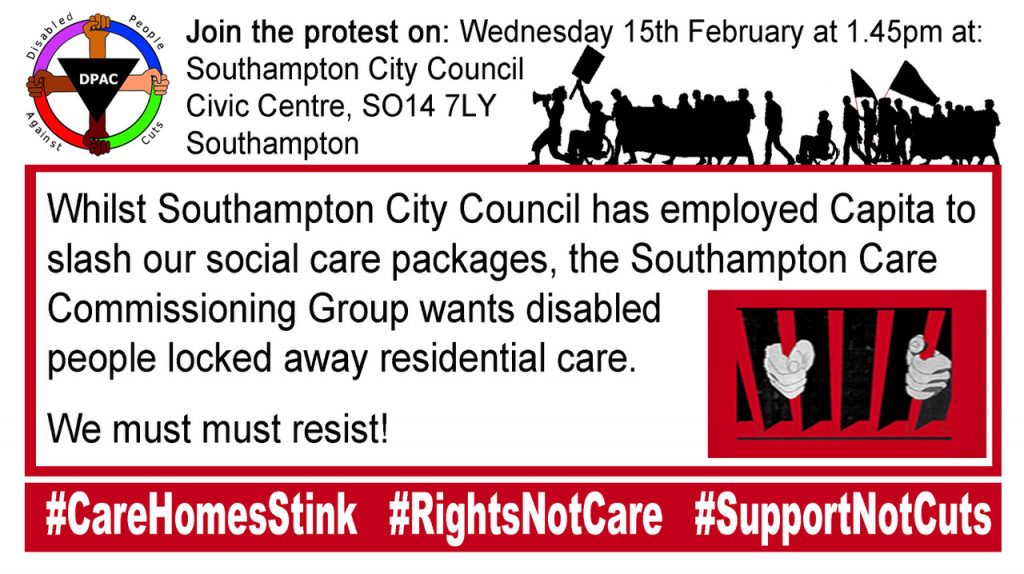
Meme for the Southampton Protest#CareHomesStink


#RightsNotTelecare


#SupportNotCuts


Details of the Protest in Southampton & Online


This letter has come from the leader of the council.


Dear Tim,
I appreciate that some of you prefer to demonstrate against the Labour Council rather than the Tory government. But if you are going to do this please have the decent thing and contact us and check whether the thing you are demonstrating against is true. I know we are in the era of ‘alternative’ truth and ‘false news but we do expect you to know better.

The Facts
1. The Care act came in in April last year and requires us to complete annual reviews of all those in receipt of a care package. This created an additional burden on our already stretched social workers. It was proposed and approved that the Council employ through Capita additional social workers to carry out these reviews.
2. No instruction was issued with regard to the outcome of these reviews. No incentive was given to Capita to save money we simply wanted the reviews done.
3. Capita were unable to recruit enough Social workers to complete the work and an offer was made to the ones they had to work some weekends for an extra payment (£200).
4. The vast majority of these reviews (all of which were carried out by fully qualified and registered social workers) lead to no change. Some were adjusted to change the way a service was delivered using modern technologies and these have lead to a saving to the Council. A saving that means less jobs will be cut this year and less other services reduced.
5. An appeals process exists with these assessments’ which has been used by precisely zero clients.
6. As part of our arrangement with Capita we are gradually taking over this work with our in house team working alongside Capita employees. We expect in due course to take over all these reviews.

These are the facts – so please tell me what you are demonstrating about.

Simon


So if those are the facts why do the leaked emails say – either the Labour council leader has no idea about what is happening in Southampton or -well – or he’s just downright lying. Take your pick.

1) From Sue Thomas, sent 15/9/16

Hi All,

The cavalry is on the way!!!

Have just heard from Adam Tait we have 3 new colleagues joining us on Monday, pulling the stops out to make sure they can ‘hit the road’ with you with the minim delay.

Adam is also suggesting some incentives for the Team. He is well aware of some of the difficulties we have had, and that you are giving me the best performance you are able.

But, now we need MORE!! The suggestions below are  cut & paste from Adams e-mail to me.

FROM ADAM’S E-MAIL

I’m not sure how weekend working might go down with the existing team (as a one off) but if we included these days we have an extra 4 days available for eight of the team people and two available for 11 of the team until we have TIB on 27th September. I would suggest we offer an extra incentive if any of the team are prepared to work these weekends or part of…. starting this weekend. It’s short notice but if we paid their existing rate at time and half or double time you may get some take up? I’m not sure if we would need to report these days within the MI suite but that’s not my call. An alternative might be payment of increased hours worked in the week. Again as a one off.

In addition, as the next week or so is so critical I am happy to roll out an extra incentive scheme at the earliest point whereby if a person manages to improve their performance by x% from the previous 4 week average they receive a £y bonus. 10% = £100, 20% = £200 etc. This can be measured across both productivity levels and the savings achieved. If one person improves their productivity by 20% and savings by 20% they receive a £400 bonus.

AGREED WEEK-END RATE TIME & HALF

PLEASE READ CAREFULLY AND CONTACT ME NO LATER THAN 5PM WITH YOUR RESPONSE (EVEN IF YIOU ARE NOT INTERESTED) THIS IS NOT A LONG TERM COMMITMENT – IT’S EMERGENCY FIRST AID TO ENSURE OUR SURVIVAL!!!!

If you want to discuss with me you’ve got my numbers.

Regards – Sue

Sue Thomas – Lead Practitioner,

Capita Review Team,

Adult Social Care,

Southampton City Council,

Southampton SO14 7LY


2) From Sue Thomas, 8 November 2016:

Good Morning,

Another late night last night – Conference Call. Followed by several hours ‘bashing my brains’ for answers.

PLEASE READ CAREFULLY – THIS IS VERY IMPORTANT

As you know our Productivity and the Financial Efficiencies we are making are under  great scrutiny.

Looking at all the figures in the Reports last night it was very clear that both Productivity and Efficiencies have fallen dramatically.

The senior managers who are leading this transformation want to know why it appears we are failing to realise the results in service delivery and savings they anticipated

By commissioning this Project. They in turn are being asked to explain to Councillors of SCC.

Issues such as changes to the Team, Reduced size of Team, Annual Leave, Bank Holidays etc. have all been taken into account but things still don’t add up.

I have stressed how hard you are all working – but we don’t appear to be getting the results we had during the Pilots.

As I said at the Team Meeting yesterday I think it may be about the ways in which we are working – IF IT’S NOT ABOUT HARD WORK, IT MUST BE ABOUT SMART WORK!!!

I HAVE PUT MY NECK ON ‘THE CHOPPING BLOCK’ – YOU HAVE PRODUCED THE RESULTS BEFORE, I KNOW YOU CAN AND I BELIEVE YOU WILL DELIVER THE RESULTS REQUIRED.

NOW I HAVE TO PUT MY MONEY WHERE MY MOUTH IS – PLEASE HELP ME!!!!!!

REMINDERS

  • BE ASSERTIVE WHEN MAKING APPOINTMENTS – SCC ARE REQUITRED BY LAW TO COMPLETE THESE ASSESSMENTS/REVIEWS (NEW LEGISLATION 2014)
  • AS MANY VISITS AS POSSIBLE BEGINNING OF THE WEEK – WEDNESDAY PM – RECORDING
  • CASE ‘OPEN’ DAY OF VISIT – MINIMISES DAYS CASE LEFT OPEN (ASSUMING INACTIVE/UNPRODUCTIVE)
  • CLOSE WHEN ANY REFERRALS HAVE BEEN MADE (MAX 2 DAYS)
  • L.D WILL TAKE A LITTLE LONGER – THIS IS RECOGNISED BY ALL.
  • 15 min. CALL OUT!! TELECARE –IN!!
  • ASSESS NEED NOT WANT.
  • ACTIVELY ENCOURAGE DIRECT PAYMENTS
  • CAREFUL ATTENTION WHEN RECORDING WORK SHEETS, YOUR WORK SHEETS INFORM THE WEEKLY REPORTS FOR THE DECISION MAKERS – DON’T SHOOT YOURSELF IN THE FEET!!
  • THE WORK SHEET IS CHANGING THIS WEEK PLEASE TAKE EXTRA CARE.

THINK ABOUT ASSET BASED ASSESSMENT, FOR THOSE OF YOU NOT FAMILIAR  I WILL BE SENDING INFORMATION.

We don’t have very much time to turn this situation around. if we can’t/don’t do it all the hard work you have put in so far will have been for nothing.

Not to put too fine a point on things WE ARE ALL ON THE WAY HOME.

I AM NOT ASKING YOU TO STAND BEHIND, ME I’M ASKING YOU TO STAND BESIDE ME SO WE CAN BRING THIS PROJECT TO A SUCCESSFUL (FOR ALL OF US!!) CONCLUSION TOGETHER.

Regards – Sue

Sue Thomas – Project Lead Practitioner,

Capita Review Team,

Adult Social Care,

Southampton City Council,

Southampton SO14 7LY


DPAC’s response to Simon:

  1. Capita offered their staff bonuses of up to £400 to cut people’s packages (Capita said  that this was never introduced but they haven’t denied that they made the offer).
  2. Capita’s freelance social workers were paid more than £1,000 a week (after tax) and put up in three-star hotels while they were encouraged to cut people’s packages.
  3. The emails clearly show that they were asked by the council to produce savings (ie cuts).
  4. The Council Leader says “. Some were adjusted to change the way a service was delivered using modern technologies and these have lead to a saving to the Council.” We do not believe Telecare is an acceptable alternative to human support and nor are packs of incontinence pads. If the council leader thinks the following email from a Capita manager is acceptable, then he should be ashamed of himself and needs to resign: The manager suggested an “extra incentive” for the team if they could improve on their previous “performance” and suggested that the bonus “can be measured across both productivity levels and the savings achieved. If one person improves their productivity by 20 per cent and savings by 20 per cent they receive a £400 bonus.” The council never commented on the ‘extra incentive’ email,  we can’t think why not.
  5. Does he also think the other email that was sent by capita to their team is acceptable? “The senior managers [from the council] who are leading this transformation want to know why it appears we are failing to realise the results in service delivery and savings they anticipated by commissioning this project. They in turn are being asked to explain to Councillors of SCC [Southampton City Council].”
  6. Another thing to note is that the whistle-blower said that it was the service-users with no support networks to advocate on their behalf with the council who were often the ones who were having their packages cut. This might explain why there have not been any appeals (if that’s true).
  7. I suspect that, if you take away the care packages that included residential care (which are almost impossible to cut), the proportion of direct payments packages that were cut is significant.
  8. I notice the council leader says that ‘No incentive was given to Capita to save money’. That doesn’t mean that they didn’t tell Capita that they wanted them to save money (which they did). My understanding is that Capita knew they would lose the contract if they didn’t make those savings. That seems like an incentive to me…
 Posted by at 14:24
Jan 132017
 
DPAC Logo with text underneath "Disabled People Against Cuts" and then web address dpac.uk.net

reblogged from Transport for All (mostly)

Wheelchair-user Doug Paulley had successfully sued First Bus Group in 2013 after he had been denied access to one of their buses because a bus driver didn’t enforce priority in the wheelchair space and a buggy owner refused to make room for him. But this decision was overturned by the Appeal Court in November 2014. The Supreme Court will now give their verdict on Wednesday.

After months of waiting, the judgment in Doug Paulley’s case vs First Bus Group is finally to be handed down at the Supreme Court next Wednesday January 18th at 9.45am. 

As you may know their decision could have wide implications for wheelchair and mobility scooter users who want to travel by bus in the UK. If the original verdict in Mr Paulley’s favour is upheld by the Supreme Court, then the requirement in law to give a wheelchair/mobility scooter user access to the wheelchair space will be absolutely undeniable, and all bus companies will have to enforce it. This is the reason why Transport for All has supported Doug from the beginning.

On this day, we would like to gather with as many Disabled and older people as possible to show First Bus Group that disabled people everywhere are standing up for our right to ride.
Join us to show our support for Doug Paulley on this historic day.


WHEN: 9am, Wednesday 18th January 2017
WHERE: In front of the Supreme Court 
(nearest accessible Tube station is Westminster. Buses: 148, 211).


Please email Raphael if you would like to join the rally:

raphael@transportforall.org.uk

Please note that at 9.45am, one of the Justices will deliver a brief summary of the Court’s decision lasting around five minutes. Due to the appalling access at the High Court the number of spaces for wheelchair users is unfortunately very limited. On top of the space booked for people who’ve got a close connection to this case, there are an extra 6 places available which will be allocated via ballot by the Supreme Court .

 Posted by at 16:14
Oct 012016
 
DPAC Logo with text underneath "Disabled People Against Cuts" and then web address dpac.uk.net

For those who were able to come to our conference on September 10th  I’m sure you all remember the absolutely harrowing video from Greece which was shown of disabled children being bound into cots and beds. For anyone who missed it you can see it again here

https://dpac.uk.net/2016/09/greeces-shocking-secretthe-work-of-zero-tolerance/

In a solidarity action with our OCAP allies in Toronto we plan to deliver a letter to the Greek Embassy in the UK. (below) demanding changes in Greece and human rights for disabled people there.

Meet Wednesday, October 5th at 10.30am outside the embassy at 1A Holland Park, London, W11 3TP


For those of you not able to attend in person please join in on twitter #GreeceSolidarity and tweet to @GreeceinUK or email  gremb.lon@mfa.gr using the below as a template.

Dear Mr. : This letter is being hand delivered by a delegation from Disabled People Against Cuts. We are here in solidarity with the Emancipation Movement of People with Disabilities: Zero Tolerance in Greece. In November of last year, they occupied a centre for disabled children and young adults in the town of Lechaina and exposed conditions of neglect and cruelty that clearly constituted an abuse of their human rights. This went to lengths of prolonged confinement in tiny spaces and the tying down of children to their beds round the clock. You may be aware that Human Rights Watch has taken up this matter and spoken in the clearest terms on the enormity of the abuses involved. You may also be aware that the horrors being perpetrated at the Lechaina centre are simply the tip of the iceberg. It is estimated that eighty five such centres are operating throughout Greece and that a huge and appalling abuse of the rights of disabled people is being perpetrated. Your Country is, of course, facing an externally imposed agenda of the most brutal austerity. Regrettably, your Government has decided to accept the logic of this agenda and embrace the infamous notion that ‘there is no alternative.’ With regard to the disgusting treatment of these disabled children, we wish to convey to Mr. Tsipras and his colleagues that an alternative must be found and the obscene warehousing of human beings that has been exposed here must come to an end. DPAC wishes to join with the Emancipation Movement of People with Disabilities: Zero Tolerance, Ontario Coalition Against Poverty and with many others internationally in demanding decent, adequate and humane conditions and services for these children and all disabled people in Greece. Thank you for your attention to this matter and we await your response. Yours truly, Ellen Clifford on behalf of the DPAC steering group

 Posted by at 20:35
Sep 262016
 
DPAC Logo with text underneath "Disabled People Against Cuts" and then web address dpac.uk.net

As well as general demands for improved rights of disabled people DPAC, Mental Health Resistance Network and Recovery in the bin have drawn up a set of specific demands for Mental Health.

After decades of oppression we believe that disabled people must be afforded self determination from the grass roots level. “Nothing About Us Without Us” must become a reality.

No Longer will we tolerate large disability charities which see us as nothing more than marketable commodities from which to make profits for their own benefit speaking for us and deciding our futures. We expect a Labour Party which claims to support disabled people’s rights to ensure that it is our voices that are listened to and not the empty voices of our oppressors. Without this guarantee DPAC cannot approve of the disability policies of any political party.

DPAC priorities for setting Mental Health  Disability Policies.

We deplore the appropriation of the Recovery Model by statutory services and government departments in order to justify the withdrawal of services and benefits from people who need them. 

Compulsory MH Training for Professionals in Various Fields

  1. Mental health training should be compulsory for all health care professionals, including doctors and nurses, and suicide awareness training should be given to all health care professionals. Such training should be kept up to date.
  2. All Police Forces should have full mental health awareness training, stop using section 136, and acknowledge that custody suites and lock-ups in police cells are not safe places.
  3. Mental health awareness training and crisis awareness training should be available for all teaching staff in primary and secondary schools, and further education institutions.
  4. A person suffering from mental distress should be treated with respect, courtesy, dignity, and consideration at all times as should and their families and friends.

Treatment Changes

 We demand the abolition of forced treatment and Compulsory Treatment Orders (CTOs).

  1. All treatment should be with the full agreement of the person being treated and with their full understanding of the side effects of treatment, both pharmaceutical and psychological.

7.We demand the right to refuse treatment as it is ratified under the United Nations Convention Rights People with Disabilities (UNCRPD)

8.We want recognition of the link between abuse and trauma, and mental distress. The British Psychological Society has already made this link.

9.We demand the recognition that child abuse prevention is also mental distress prevention.

  1. We want the abolition of the medical model of mental distress to be replaced with an acceptance that mental distress is part of the human condition and is a normal response to adverse events and circumstances. Appropriate care and support should be the right for all people suffering from mental distress.
  2. Long term psychological treatments should be provided freely to all who need them and talking therapies should not be restricted to short term interventions. We recognise that not everyone wants talking treatments and this should be respected.
  3. The person experiencing mental distress should decide their care and always have their wishes respected.
  4. There should be a recognition that the use of alcohol and drugs are a form of self medication for many in mental distress. Drugs should therefore be decriminalised.

14.Access to detox and drug rehab programmes should be available to everyone.

15.We demand recognition that many social values that are common place, such as competition being intrinsic to human relationships, are erroneous and cause harm to people’s mental health.

  1. Bereavement counselling should be made available for all children who lose a parent or supporting person. 

Financial Needs – Individual and Other Support

  1. We demand recognition that the WCA and PIP assessment processes are detrimental to people’s mental health and should be scrapped. The money saved by not paying Private Companies to carry out these assessments should be re-invested into better services.
  2. We demand guaranteed financial security and appropriate housing for everyone experiencing mental distress.
  3. No aspect of the social security system should cause distress or deterioration in a claimant’s mental health condition.
  4. Funding should be provided for Crisis Care to be made available for help and support 24 hours a day, 365 days of the year.
  5. Funding should be made available for the setting up of Crisis Houses as safe spaces. Access to these should be every person’s right and should include ‘sitters’ who will be there to support people throughout these times.
  6. We want hospital beds to be replaced with beds in settings similar to domestic environments.
  7. More provision of services for children and young adults. 1 in 10 children are being denied mental health service support which is having a huge impact on the family and schools.
  8. Concessionary travel passes should be made available to all people living with mental distress to enable independence in the community and to attend appointments with health care professionals, thus aiding mental wellbeing.
  9. We want special support centres for young men who are suicidal and a paradigm shift away from the “norms” which are set as ideals of masculinity and may contribute to the high rate of suicide in young men.

26.Funding should be made available for research into mental health care that is based on a Social Model of mental distress; such funding should at least equal the current amount of money available for pharmaceutical research.

27.We demand the provision of special support for people with mental distress to ensure their children remain with them as a family.

  1. We demand a holistic approach to care – where a person has both a physical and a mental health problem, such impairments should be treated equally with respect and with dignity and with full understanding that a physical impairment can impact on a mental health impairment and vice versa.
  2. We want specialist support to be made available for ALL armed forces veterans who experience mental distress and for housing to be made available to them.
  3. We deplore the underfunding of mental health services in the NHS and the current practice of discharging people with mental health problems from secondary care into primary care where their needs cannot be met. These services should be properly funded.


Other

  1. Any crime against someone with a mental health condition should be treated as a hate crime.
  2. We want an ongoing campaign to end all bullying in schools and work places and within families and general society where such bullying is linked to mental distress.
  3. Action should be taken to end the ongoing discrimination against LGBT people as such discrimination can lead to mental distress.

Further Investigations Needed 

  1. We demand a full investigation into the effects of long term use of psychiatric medications and demand that mental health professionals treat reports of side effects of medication seriously.
  2. We want a full investigation into the appropriateness of the continuous use of medication as the main form of treatment for people in mental distress.


  1. We demand a full public inquiry into the impact on people in mental distress of being detained in Prison Environments.
  2. We want a full investigation into why so many people from BME communities are being diagnosed with a mental health condition.
  3. We want an investigation into the harmful effects of E.C.T.
  4. We demand an inquiry into the success or otherwise of the use of personal budgets for day care provision for people living with mental health problems.
  5. We demand a full public inquiry into the significantly shortened life expectancy of people with mental health conditions and a full report produced with recommendations which should be implemented.


Disabled People Against Cuts (DPAC)

www.dpac.uk.net

mail@dpac.uk.net

@dis_ppl_protest

 Posted by at 21:47
Dec 082015
 
DPAC Logo with text underneath "Disabled People Against Cuts" and then web address dpac.uk.net

Seeing the light…

Introducing Switched On London, a new campaign coalition demanding clean, affordable and democratic energy in the capital through publicly owned energy and supported by DPAC.

www.switchedonlondon.org.uk | @SwitchedOnLDN

The floods in Cumbria are a reminder of how close to home the impacts of climate change are being felt. Three once-in-a-hundred year floods in ten years aren’t an indication of terrible misfortune, but of a new baseline. As leaders and business executives meet in Paris with the outcome uncertain, in London the fight for clean, affordable energy is being taken in a new direction.

In the face of a cartel of energy companies whose turn to renewables is far too slow — and whose profit-hungry business model leaves thousands struggling between heating and eating in the winter — Switched on London is a new campaign launching to build energy democracy in London. We demand that the GLA (Greater London Authority) sets up a new public energy company that works for people, not for profit.

The needs for clean energy and for affordable energy are deeply connected. We have already waited far too long for the private sector to ride to the rescue and deliver renewables.The big energy companies’ commitment to fossil fuels is as profound as their drive to make enormous profits, which have increased ten-fold since 2007. We need to democratise our approach, including people in decisions about their own energy, and giving the public sector the capacity to invest in new sources of clean power and energy efficiency.

In spite of the Tory government’s bizarre attack on the community energy sector, there remain some tools open to the public sector to challenge the dominance of the Big Six. An announcement last year indicated that the Mayor of London had seemed to be using one of these – called ‘Licence Lite’ – to step in to provide a route between public and small-scale energy producers and big consumers such as Transport for London. ‘Licence Lite’ could have given the GLA the chance to break the Big Six’s control over energy supply.

Sources within the GLA this week, however, have revealed that Boris Johnson, far from doing this, has signed off yet another contract with one of the big energy companies themselves, RWE nPower. They will run the scheme, providing billing and administration; tasks they’ve proved singularly bad at in their own business.

This is another blown opportunity by this mayor. After decades of flawed competition and rising prices, over one million Londoners are in fuel poverty, thousands die every year from air pollution, and the commitment to deliver renewable energy is falling short. While major European cities like Munich and Copenhagen are committing to 100% clean power, London is lagging behind. It doesn’t have to be this way.

Switched On London is putting forward a proposal that could help the Greater London Authority become the tap-root of a new energy system in our city. We’re a broad coalition of community organisations, trade unions and NGOs coming together to propose a bold but achievable vision of a very different energy future: one geared around ordinary Londoners, not powerful business executives.

We want a new non-profit company that offers fair, affordable prices, reinvesting in energy efficiency and tackling fuel poverty. By taking public control we could directly drive investment in the 21st century renewable energy sources London needs. With a range of democratic mechanisms – from elected board-members to open borough assemblies and public referenda on important issues – we could truly shift power to people’s hands.

This is a perfectly realistic goal. London could start moving rapidly by divesting its £4.8bn pension pot from fossil fuels. It could launch municipal bonds to fund new clean energy sources, as it did for Crossrail.

Local authorities like Nottingham and Bristol have already taken steps in the direction of public energy along with dozens of cities across Europe. Londoners have had to live with a broken energy system too long, and it’s time to change it.

www.switchedonlondon.org.uk | @SwitchedOnLDN


 Posted by at 15:05
Jul 052015
 
DPAC Logo with text underneath "Disabled People Against Cuts" and then web address dpac.uk.net

Wolverhampton South MP Rob Marris’s Assisted Dying Bill is going to be debated and voted upon in what’s known as it’s Second Reading in the House of Commons on September 11th.  This is the first time in 18 years that MPs will have had the chance to vote on an assisted suicide (AS) law.


We want to make sure that MPs vote ‘NO’ and kill the bill on September 11th. see also info about the lobby on 14th July


We need to talk to our MPs about our fears and concerns about such a bill, to find whether they’re for or against it and if the latter, we desperately need them to attend on 11th September to vote against this bill.


This information sheet is the legal one.  It details the current legal situation and looks at the details of these assisted dying bills.


The current situation


Those of us who oppose a change in the law, believe the current situation is adequate.  Under the 1961 Suicide Act, killing yourself is not illegal but encouraging or assisting another person’s suicide is and can lead to up to 14 years imprisonment.  The current law acts a deterrent to malicious or manipulative assistance with suicide.


But the Director of Public Prosecutions (DPP) also has a discretion not to prosecute if, for example, it is clear that assistance has been given reluctantly / after serious soul-searching or for ‘wholly compassionate’ reasons to ill or disabled people.  It is this discretion that has allowed the high profile assisted suicide cases to avoid prosecution.


There are a list of factors considered when deciding if the law has been broken but in reality, if a person has made it clear that they want to end their life by an assisted suicide for health / impairment reasons and a friend or family member aids them (as opposed to a medical professional) then whilst they may be investigated, it is unlikely that they will be prosecuted.  Infact less than 20 cases a year throughout the whole of England and Wales cross the desk of the DPP and few of them call for prosecution.  And yet apparently this law isn’t working?


But laws send out messages – when something is legalised, it acquires the stamp of social approval.  An assisted suicide law says, in effect, that if you are terminally ill, ending your life is an option that it is appropriate to consider.

And by putting assisted suicide into the hands of the medical profession, it’s feared it could become a treatment option.


Critics of the current law say that it’s unfair for families and friends to have to help an ill or disabled person to end their lives and not know in advance whether or not they’ll be investigated and charged.  We say the illegatlity of the assisted suicide acts as a deterrent and ensures it is not the easy option.


Supporters say that because it’s not currently legal for a Dr to assist, that people have to kill themselves with amateur means which may fail.  We say that everyone has the means to commit suicide and why should ill / disabled people be given a 100% successful method when over 90% of suicides for everyone else actually fail?


They say that dying people may have no choice but to take themselves off to somewhere like Dignitas before they’re ready to die but while the person is still well enough to travel – and that travelling to Dignitas is costly and difficult for those involved.  We say that rather bringing assisted suicide to the masses and make it an easy option,  that there should be improvements to end of life care for all people to ensure everyone can have a peaceful and pain free end to their life.


Supporters say they want the right to die.  We believe the right to die already exists for each and every one of us. What those wanting a change in the law are actually asking for is the right for someone else to kill them.


Instead of a discretionary power where very few assisted suicides are ever prosecuted, supporters of a change in the law want to lay down in advance, the situations when it is okay for a Dr to assist a person to end their life.  We say the law as it is enables the choice of a few whilst protecting the many.


What’s in the Assisted Dying Bill?


At the time of writing the text of the Marris bill is unknown but it’s likely that it will be very similar to the Lord Falconer Assisted Dying Bill that Not Dead Yet UK protested against in the previous Parliament. (Lord Falconer has also re-introduced his Assisted Dying Bill into the House of Lords so even if we defeat the Marris Bill in the Commons, we will still have to contend with Falconer at some point in the future!).  Firstly they’re calling it an assisted dying and not an assisted suicide bill.  They say it’s because it’s only for those who are actually dying but we say it’s to make the term more palatable, after all, the current campaigning group Dignity in Dying used to be called the Voluntary Euthanasia Society.


If passed, the ‘assisted dying bill’ would license doctors to supply lethal drugs to:

  • terminally ill patients with less than 6 months to live and who have,
  • a settled intent to end his or her life
  • the capacity to make such a decision and
  • are making the request voluntarily, on an informed basis and without pressure or duress


Two doctors are required to certify that these criteria have been met and their decision is to be referred to a judge of the High Court for confirmation.  There is no requirement for a psychological assessment to assess capacity.  The doctors do not have to be your regular doctors.  If approved, the person would be supplied with the lethal drugs to enable them to commit suicide.

A medical professional (but not necessarily a doctor) would remain with the person until they died but they cannot help them to take the drugs – to do so would cross the line between assisted suicide and euthanasia.


Many people who support this bill believe it is to assist those who cannot kill themselves to have the same opportunity as everyone else but in fact, if someone cannot physically ingest or do the final act themselves would not technically come under this bill.


The proposed law – unsafe to change


Critics of the bill are meant to be reassured by ‘safeguards’ to protect ‘the vulnerable’ from abuse – and ultimately murder.  So what safeguards exist to protect someone from being killed without their fully informed consent?


The proposals list a number of qualifying criteria for assisted suicide – such as settled intent, capacity to make the decision and freedom from pressure – but they do not translate these criteria into concrete safeguards.  Instead, they

propose that these issues should be dealt with by the Secretary of State in codes of practice AFTER Parliament has agreed to change the law.  SO MPs don’t even know the full extent of what they’d be voting for on September 11th. In effect, the issue of safeguarding has been side-stepped and Parliament is being asked to sign a blank cheque.


After concern about lack of safeguards was raised when the House of Lords debated the Assisted Dying Bill, Lord Falconer added a proposal that when a doctor assessing a request for assisted suicide considers that it meets the designated criteria, the decision should then be referred to a judge of the High Court for confirmation.  The bill does not, however, require the Court to undertake any investigations of its own and as such, the role envisaged for the Court is little more than that of a rubber stamp.  It is expected this will also be included in the Marris Bill.


Many aspects of a request for assistance with suicide go beyond a doctor’s professional competence.  It may be fair to ask a doctor to confirm that a patient is terminally ill, to offer a prognosis and to advise on possible treatments.  But most doctors are in no position to judge whether a request for assistance with suicide derives from a settled wish or whether there are any pressures operating in the background that could be influencing the request.  In today’s world of busy multi-partner GP practices and declining home visits doctors often know little of their patients beyond what they pick up in the consulting room and they do not have the time or resources to set about investigating such matters.


The Oregon Experience


The Oregon Death with Dignity Act has been the blue print for the Falconer Bill and will be no doubt for the Marris Bill too.  Here are some of the problems with the Oregon law:


  • Individuals seeking assisted suicide can resort to doctor shopping- visiting doctor after doctor until one agrees to write the lethal prescription.


  • Patients are often misdiagnosed as terminally ill with less than 6months to live when in fact they live for months and even years beyond what was originally expected.


  • Individuals with a new illness or disability are often faced with depression, which requires more than Oregon’s 15 day waiting period to be treated.


  • Many patients experience outside pressure to commit assisted suicide, which often goes unnoticed and unpunished.


  • Individuals are often portrayed as a burden on their families and are made to feel that their life is not as valuable.


  • In 2007, none of the individuals that requested assisted suicide in Oregon were referred for a mental health evaluation.


  • Under Oregon law, depressed or mentally ill individuals can still be considered “competent” to request assisted suicide.


  • Under Oregon law, doctors that fail to report or file incomplete or inaccurate reports face no penalties.


  • All records are sealed and all underlying data is destroyed after the annual report is published.


  • The 2013 Oregon statistics reveal that the three main reasons given for requesting an assisted suicide are loss of autonomy (93%), decreasing ability to participate in activities that make life enjoyable (88.7%) and loss of dignity (73.2%).  By comparison, inadequate pain control or concern about it was one of the least important concerns at 28.2%.


  • Assisted suicide is also legal in Washington State. The 2013 annual report has shown that 61% of all those who were supplied lethal drugs in order to commit suicide listed the feeling of being a burden on family, friends or caregivers as one of their main reasons for their request.


  • 64 year old Barbara Wagner was diagnosed with metastatic lung cancer. Her oncologist prescribed chemotherapy to slow cancer growth, reduce symptoms, and extend her life.  The Oregon Health Plan however would not cover the costs for her chemotherapy prescription, but sent her a letter saying they would instead pay for assisted suicide drugs.


May 112015
 
DPAC Logo with text underneath "Disabled People Against Cuts" and then web address dpac.uk.net

Secret Changes to Motability Grant Making Conditions – People needed for Legal Challenge

Motability have introduced changes to their grant making conditions discriminating against disabled people with the highest support needs who are unable to work for a minimum of 12 hours a week, carry out at least 12 hours voluntary work (which apparently can’t be internet based but has to be outside the home and doesn’t include travelling time), are not in education for at least 12 hours a week and who need specialised adaptations to transfer to drive or drive-from-wheelchair vehicles.

These changes have not been made publicly known or advertised to current customers in any way about who is eligible for a grant and the changes were made without any consultation.

We understand these changes were made from June 1st this year but customers are only being told about them when they enquire about a grant for a replacement vehicle.

The impact of these changes which affects those with the highest and most costly needs are potentially life-changing. It could well prevent people having contact with family (let alone friends) if they live in a rural area with little or no transport, it means anyone who can only travel with equipment like hoists. Oxygen cylinders and other bulky items won’t be able to go anywhere. It also ignores the fact that with other cuts to services people will not be able to ensure they have the physical support from someone else to drive them.

We have sought legal advice to see whether these changes can be challenged as discriminatory and now need to hear from anyone who is or would be affected by these changes in the near future and who would qualify for legal aid. In particular we want to hear from anyone who currently does not have a vehicle and has been refused the right to apply for grant funding.

If you think you might be affected by these changes and are willing to consider taking legal action then please contact us at  mail@dpac.uk.net

https://www.disabilitynewsservice.com/motability-face-court-action-discriminatory-new-rules/


 Posted by at 20:33
Mar 312015
 
DPAC Logo with text underneath "Disabled People Against Cuts" and then web address dpac.uk.net

Sign in support of the campaign now! 

Email Henrietta.doyle@inclusionlondon.co.uk with the name of your organisation or as an individual.

Ultimate aim of the campaign

Motability agrees to reverse the changes to eligibility criteria for Motability’s Special Vehicles Fund for Drive-from-Wheelchair/Internal Transfer (DFW/IT) vehicles used by disabled people with complex needs. 

Other aims:

·        Motability agrees to conduct a formal public consultation on the changes, including a face to face meeting with current grant users. Until this consultation is concluded and a consultation response report publicly published the changes should be immediately reversed.

·        Motability agrees to publishes  their equality impact assessment of the changes

·        Motability agrees to publish clear and full information about the changes on their website. 

Why the need for the campaign?

Motability has changed the eligibility criteria for their Special Vehicles Fund (SVF) for Drive-from-Wheelchair/Internal Transfer (DFW/IT) vehicles used by disabled people with complex needs. We believe these changes could destroy the ability to live independently and be included in the community of those affected. 

What are the changes?

From June 2014 ‘a usage test’ was introduced by Motability regarding DFW/IT vehicles.  This test applies to those applying to the SVF first time and current users when renewing their contract (see statement provided by Motability attached). Below is information on how the changes are being implemented in practice.

Current users are telephoned some months in advance of the renewal date of their contract and asked if the vehicle is to support ‘substantive employment, education, volunteer working or to enable the disabled driver to provide vital and sole care to another, for example, a school-age child or children or a disabled loved one who resides with the disabled person.’  About 12 hours a week seems to be considered ‘substantive’. It appears that those that do not fulfil this criterion are no longer eligible for a vehicle.

We are very concerned that disabled people who rely on access to such vehicles will no longer be eligible for grants from the scheme and therefore unable to replace vehicles, which are essential to their independence. These vehicles are often used by disabled people with the highest support needs, who for a range of reasons relating to their impairments, are unable to access public transport because it unavailable or not possible because of pain levels or the need to carry equipment such as hoists or oxygen or a particularly large vehicle as illustrated in the case study below:

Case study

Because of the specialised seating on my wheelchair, it is too large to travel on bus.  Only 3 weeks ago I couldn’t go to hospital Emergency A&E because the ambulances can’t take me!  I was severely dehydrated, they ended up sending a doctor to my home and doing 48-hour IV just because I couldn’t go to hospital.  

There is NO way I am every going to be employed which is depressing enough, I can’t get  voluntary work because I can’t even go and see anyone to consider it (no transport!).  I really am so depressed over these changes. 

These new changes mean I am confined to the distance of my own wheelchair with no access to public transport, and no access to Motability.

The impact

The independence given to disabled people to drive their own vehicle often means they can become involved in their community and do voluntary activities. Without a DFW/IT vehicle many disabled people will be excluded from visits to families and friends and will be unable to take part in any aspects of social, religious, community, wellbeing activities and political life.  In addition these changes will prevent disabled people getting into education, obtaining employment or volunteering unless already involved in these activities and therefore will never fulfil the new criteria for a DFW/IT vehicle.

Motability did not conduct a consultation before implementing these changes and as far as we are aware they did not carry out an Equality Impact Assessment regarding the impact of the change, also there was no public announcement or any information published concerning the changes.   Disabled people only become aware when asked the questions on the telephone. There is still only limited information given by Motability at: https://www.motability.co.uk/understanding-the-scheme/financial-help/eligibility-for-financial-help

Motability administers government funds, yet they seem to be ignoring the Equality act and the UN Convention on the Rights of Persons with disabilities, which states the duty to facilitate:

·        ‘the personal mobility of persons with disabilities in the manner and at the time of their choice’

·        access to ‘quality mobility aids’

·        disabled people’s right to ‘full inclusion and participation in the community’.   

Disabled people’s organisations are acting together with other voluntary sector organisations to ask Motability to reverses the changes to the eligibility criteria for the SVF for DFW/IT vehicles.

What can you do?

·        Sign in support of the campaign by emailing Henrietta.doyle@inclusionlondon.co.uk

·        Sign the petition at: https://www.change.org/p/stop-unfair-and-secret-changes-to-motability-grants#petition-letter   2,500 people  signed in the first 3 weeks!

·        Promote petition, email, Facebook, Twitter etc.

·        Send letter of protest and case examples to Motability.

·        Survey members on their experiences of Motability reviews

·        Contact your local MP, and relevant Ministers

Join the coalition of disabled people’s organisations and voluntary sector organisations supporting the aims of the campaign above, to do this please email Henrietta.doyle@inclusionlondon.co.uk with the name of your organisation. 

Please forward this email to your contacts. 

Many thanks,

Henrietta

Henrietta Doyle

Policy Officer

Mobile: 07703 715091

Direct line (Wednesday’s only) 020 7036 6033

Office Tel: 020 7237 3181, SMS: 0771 839 4687

www: https://www.inclusionlondon.co.uk/

 Posted by at 19:07
Mar 222015
 
DPAC Logo with text underneath "Disabled People Against Cuts" and then web address dpac.uk.net

Press Release

Anti UKIP campaigners are staging a protest now in the local pub of UKIP leader Nigel Farage in the village of Downe, Kent.

Nigel Farage’s local pub the George & Dragon where he has been pictured many times going for a drink has been invaded by about 80 people protesting against UKIP.

Campaigners include those who have been targeted by UKIP such as migrants, HIV activists, gay people, disabled people and breastfeeding mums.

Protest organiser  said:

UKIP are a con. They pretend to be anti-establishment but this couldn’t be further from the truth. By wrongfully shifting the blame for the economic crisis onto immigrants they have let the bankers off the hook. That is why so many diverse communities have taken our cultures to the heart of where they exist – Nigel Farage’s local pub. We will not succumb to their prejudice. We will create the world we want to live in. A world beyond UKIP.

We sympathise with people who feel alienated with the political system but a vote for UKIP really is the worst thing you could do to protest about the current state of this country.

a social worker from London said:

“The alliance of people here today shows that there are clear targets of UKIPs hate filled agenda. We want to live in a society in which we are all valued and our different contributions, talents and cultures are acknowledged. 

We want politicians to stop using the language of divide and rule, xenophobia, racism and fear and instead speak up to the 99% to challenge the corporate greed and massive inequality that exists in this country and globally”.

ENDS

Notes to Editors

  • Full address of the Pub: George & Dragon, 26 High St, Downe, Orpington, BR6 7UT
  • We have photographers on the protest who will be able to provide photos in the next few hours.
 Posted by at 12:32
Feb 252015
 
DPAC Logo with text underneath "Disabled People Against Cuts" and then web address dpac.uk.net

Reposted from the brilliant Kate Belgrave https://www.katebelgrave.com/ with thanks

Readers of this site will remember that a couple of weeks ago, I posted questions about people’s right to record and film face-to-face assessments as they go through the work capability assessments that are to be run by Maximus.

I wanted to know if Maximus will allow people to record their face-to-face assessments on their phones or any recording gear that they have – from the pointwhen Maximus takes over the grisly WCA process. I also had other questions, which I put to Maximus last week. I’ve listed these questions below, along with the answers (perhaps I should say “answers”) I got back (had to lean on Maximus’ US office for a response in the first instance, but got one of sorts in the end).

Needless to say, the entire exercise was a complete waste of time. You’ll see below that the responses give us five-eighths of fuck all as far as concrete information, timelines and/or actual process detail is concerned. No surprise there, of course – but I thought I’d post the responses anyway, because I think there is merit in highlighting the PR guff and detail-free twattery that Maximus has decided to specialise in when it comes to this contract. There’s also a dismissive aspect to a lot of the language, which you might find illuminating – a sort of “we’ll do things at our pace and you lot can wait” – air which nettled me badly. It should get on your nerves, too.

This sort of thing, for example:

Change cannot occur overnight”

[We] will take forward this and other ideas to the Department for their consideration”

I am unable to comment on such speculation,” when I raised a perfectly valid point about Maximus’ view of the future of the ESA Support Group.

Sue Marsh actually got in touch with me after the press office did to say that I could speak with her, because my questions “come under her job,” but that attempt at overture got right up my nose, as well. For one thing – if Sue Marsh is the person who is best placed to answer questions in the sort of details required, then the Maximus press office should go to her for those answers before responding to whoever asked them. It’s not my job to sweep together Maximus’ various outputs on its own assessment processes as and when those outputs drop out of different holes, or to wait around for the responses that Maximus feels it has best finessed. For another thing – I can’t see myself responding well to any aspect of the many-pronged charm offensive that Maximus has launched in its sorry and very costly attempt to sculpt and polish the WCA turd. Let’s face it – any company that comes out with a phrase like “more touch, more communication,” apparently in all seriousness, should not be encouraged to contribute further to any dialogue on any topic, or to remain involved in any process where people require something better than bullshit. It’s my view that in a general sense, any company that speaks lines like “more touch, more communication,” needs a smack in the soft parts right there.

Anyway.

Here are the sorts of responses you get if you ask Maximus questions about recording face-to-face assessments, or about support for people with mental health conditions as they go through WCAs, or whether or not Maximus would bid for contracts to “provide” work-focused activity for people in the ESA support groupif people in SG are ever pushed into such activity. I just want to give you a feel for the sort of Jog On contempt that those who ask for actual details about processes are treated with.

Opening response from Maximus:

We are firmly focussed on managing a stable transition for next week. Naturally when we are up and running we will want to introduce innovative changes to the customer experience but they have to be done with DWP consent and change cannot occur overnight.”

Well – that’s a Fuck Off if I ever heard one (and I’ve heard plenty of them). I think it’s the “Naturally” that makes me want to punch the screen when I re-read that effort. May I say that I’ve had enough of the phrase “Customer experience” as well. People who must go through the work capability assessment are not “customers.” They’re not wafting around a pick and mix display, or selecting iphones from a catalogue. They’re sick and disabled people who must endure an outsourced assessment process at the hands of voracious private companies that are in turn hired by governments which are absolutely intent on selling the idea that everyone on a benefit is a scrounger. There’s no customer choice or shopping around going on here. The government is the customer – not the people who the assessment process is inflicted on.

Ho hum. Here are the questions and answers, then. Short and not particularly sweet, etc:

Recording face-to-face assessments:

My question:

Re: the recording and filming of WCA face-to-face assessments. Will Maximus permit the audio recording and filming of WCA face-to-face assessments? If so, how will assessment recordings operate? Will people be able to record and film their assessments using their own recorders and cameras? This is an important point for people going through WCAs – without a recorded file of their assessment, there is little transparency of the face to face aspect of the process in particular. The DWP and Atos were challenged by lawyers on this point and forced to change protocol.”

Maximus response:

In respect of recordings we are studying this and will take forward this and other ideas to the Department for their consideration. We agree there are merits to this change, but there are other considerations as well, including the potential for the customer to be potentially constrained because some people are shy when being recorded. We want to ensure customers feel as comfortable through this process as possible, so all of these factors must be considered.”

Right. As it happens, a simple Yes or No would have sufficed here. Maximus could instruct its assessors that from of the start of the contract, people can record and film their assessments on their own recording gear if they want to, or bring someone along to do that (as I’ve said before, I’ll do it anyway. The hell with it). When Atos was in charge of this shambles, people had to ask for a change of appointment until they could get one with an assessor who was prepared to be recorded and where the dual recorders that Atos and the DWP insisted on were available. As for “the potential for the customer to be potentially constrained because some people are shy when being recorded” – I would have thought the answer to that one was simple. People – sorry, “Customers” – don’t have to record their assessments if they don’t want their assessments recorded. Naturally.

I can’t believe we’re still talking about this after all these years. Surely there is a limit to the number of times that the DWP and its providers can arse about on this subject? I’m also unclear on the basics here. Can people still ask for a recording to be made on official equipment? Does Maximus have enough equipment to meet demand?

Next up was:

My question: assessments for mental health claimants:

I asked: “What protocols and guidance will Maximus have in place for assessments for people with mental health conditions? Atos came in for considerable criticism regarding its failure to accurately assess ESA claimants with mental health conditions. Could we discuss the structures that Maximus will have in place and the training that assessors who conduct assessments for mental health claimants will have?”

Maximus response:

With regard to assessing claimants with MH conditions we have established a Customer Representative Group with MH charities on this. One of the group activities will be to review training materials so that they better reflect MH issues. We are also review the use and numbers of MH champions in the business as well as employing OTs who often have extensive experience at supporting people with MH issues in work and life.”

You can understand why I found this underwhelming – ie barely worth reading. I suppose that I was hoping for something a little more robust and detailed than plans for reviews, and more chat and roundtables with, presumably, the usual charities. I wrote extensively on Atos’ evasiveness on the work and effectiveness of these so-called Mental Function Champions (and found at the time that Atos didn’t report to the DWP on the performance or otherwise of those “champions.”) Just a little history on the sorts of shenanigans you can get on this topic: In 2012, Mark Hoban told parliament that “we have introduced a mental health champion in every single assessment centre throughout the country.” Actually, he hadn’t. The DWP told me that 60 mental function champions were in place and that they largely worked a phone advice line. A group of us had to work for months to get Atos and the DWP to agree to a meeting about the WCA and these “champions” with charity workers from a couple of small, independent mental health charities – ie the kind of organisations that weren’t generally invited to roundtables or to share their views on the DWP and Atos with the DWP and Atos. The whole thing was a total pile and to this day I speak with people who have mental health conditions and talk about suicide when discussing their next WCA. Why people can’t simply be assessed by their own GPs and support teams is beyond me (and that goes for all sick and disabled people who need benefits. The WCA isn’t required at all – unless, of course, your aim is to push the idea that work for all is great and that people who receive benefits shouldn’t).

Moving on:

My question: the future of the ESA Support Group:

I asked: “There have been reports of people placed in the ESA Support Groupreceiving letters from jobcentres calling them to work-focused interviews. Would Maximus consider bidding for any contract to provide welfare-to-work or work programme-type schemes if the government decides that people in the Support Group should engage in work-focused activity?”

Maximus response:

The company simply said that it was unable to comment on such speculation.

To which I say – Bollocks. I asked a perfectly legitimate question about Maximus’ view of the future of the Support Group. As Benefits and Work explains: “the ESA support group is for claimants who the DWP consider to have such severe health problems that there is no current prospect of their being able to undertake work or work-related activities.” So. Either Maximus respects the idea of the integrity of a support group which exists for people who are exempt from work and work-focused activity, or it doesn’t. If it does respect that idea, it won’t consider bidding for any future contracts for work-focused activity for people in the Support Group, if that is a line that the government decides to pursue. Which the government will. It already has. The DWP already sends letters to people in the support group asking them to attended work-focused interviews. Simple as that really.

Anyway – that’s Maximus. Not a lot of joy there. Perhaps I will try putting these questions to them again during next week’s day of #scrapWCA action. Details of activities here.

Follow Kate on twitter : @hangbitch

Jan 072015
 
DPAC Logo with text underneath "Disabled People Against Cuts" and then web address dpac.uk.net

Hannah a research student at LSE is carrying out research which doesn’t seem to be done by anyone else on how people are managing being left without money if they have asked for a Mandatory Reconsideration of an ESA decision. We think having more information about this process is vital but of course the government aren’t bothering to monitor the impact.

If you or anyone you know can help with this research, or if you have avoided asking for a Mandatory reconsideration because you wouldn’t have managed to be left without any form of income please contact Hannah directly.

************************************

Have you applied for ESA? Are you going through the Mandatory Reconsideration process? I am conducting a piece of research about individual’s experiences whilst they wait for their MR decision.

If you are interested in helping please contact Hannah: h.j.chetwynd@lse.ac.uk


 Posted by at 16:03
Oct 272014
 
DPAC Logo with text underneath "Disabled People Against Cuts" and then web address dpac.uk.net

On 14th November IDS is to open a ‘Jobs Fair’ at the Chingford Assembly Hall, Station Road, Chingford, E4 7EN

Spread this info to as many people as you know but especially to groups of Unemployed and disabled people. We must ensure that IDS gets a welcome he will not forget!
Join Class War and other groups from 10 am. Class War will be in attendance until 5pm when this ends. Trains from Liverpool Street to Chingford take 26 minutes.
Iain Duncan Smith - Jobs Fair poster


 Posted by at 18:57
Oct 272014
 
DPAC Logo with text underneath "Disabled People Against Cuts" and then web address dpac.uk.net

DWP PARLIAMENTARY SELECT COMMITTEE FINAL EVIDENCE SESSION ON ACCESS TO WORK INQUIRY.

WHEN: Wednesday, 29th October 2014.

TIME: 9.30 a.m.

GIVING EVIDENCE: Mark Harper MP, Minister for Disabled People.

Colin Stewart, Work Services Director.

WHERE: Wilson Room, Portcullis House, Bridge Street, London, SW1A 2LW

Please note, BSL sign interpreter will be provided in the public gallery of the Wilson Room.

TV Channels to watch the session on, BBC Parliament and Democracy live, BBC Parliament recording will include BSL sign interpretation of the session, or you can watch on the internet www.parliament.uk click on what’s on, click on select committee, scroll down to DWP select committee and click on video if watching via computer or laptop.

HOW TO GET THERE: nearest underground station is Westminster, step free access is on Jubilee Line, accessible lift to ticket hall, then accessible lift to street level.

Buses that stop nearest to Parliament are, 3, 11, 12, 24, 53, 87, 88, 148, 159, and 211.

Please allow extra time to get to Portcullis House as security level is set at Severe, wheelchair access entrance is located at the front of the building in the middle, press the wheelchair symbol, and go through security, then to the reception desk and ask for Wilson Room, (a member of staff will escort you to the lift and the floor of where the Wilson Room is located.)

The final session of the Access to Work Inquiry will include the following:

To explore the Government’s position on a range of issues highlighted during the inquiry.

Potential for substantially increased funding of AtW in line with the recommendations of the Sayce Review.

DWP’s general approach to the administration of the scheme, including its approach to self employment and entrepreneurship.

Specific administrative issues including paper based application and invoicing processes and the recently introduced call centre system.

The clarity, transparency and consistency of the award decision making and review processes.

The level of disability awareness of DWP Staff administrating the scheme.

The guidance on funding for support workers.

Referral routes into the workplace, mental health support services and AtW employer cost sharing arrangements.

 Posted by at 10:50
Oct 212014
 
DPAC Logo with text underneath "Disabled People Against Cuts" and then web address dpac.uk.net

More and more people are asking what is happening with Access to Work, the programme that supports Deaf and disabled people to get into and stay in employment, as changes are making it harder and harder to use. Despite the government’s well publicised extra investment in the scheme Access to Work’s clear direction of travel is to cut individual packages, with the result that the employability of Deaf and disabled people is being seriously undermined.

When the Tories closed the Remploy factories in 2011-2012 they said there was no place for segregated workplaces in modern society and the money used to fund the factories would be better spent supporting Deaf and disabled people to get into and stay in mainstream employment through the Access to Work programme.

Over the past year, with the factory closures out of the way, changes introduced to the AtW programme have decreased eligibility, brought considerable distress and uncertainty to customers who had previously and successfully used the programme for many years, pushed Deaf and disabled people out of jobs and left others fearing for their futures.

It is difficult to summarise all the changes: AtW is awarded on a discretionary ‘case by case’ basis and the programme has always denied the existence of any blanket rules for particular impairment groups. What we have seen emerging are some clear patterns around the cutting of packages, lack of information and hostility to AtW customers alongside growing inefficiency and cuts to AtW service delivery.

The first clear pattern emerged with respect to Deaf customers who suddenly found themselves labelled as ‘fraudsters’. Individuals contacting AtW advisers, in some cases advisers they had had for many years were greeted with a completely different and hostile attitude. They were told ‘there are high levels of Access to Work fraud in the Deaf community’. Changes brought in including the notorious ’30 hour rule’, requiring Deaf customers using more than 30 hours of BSL interpreters per week to employ a salaried interpreter, have literally left Deaf people unable to continue in their jobs.  The government has sought to justify what it is doing by pointing the finger at interpreters, blaming them for ‘costing too much’, meanwhile undermining what is a highly skilled and important profession.

A particularly nasty move has been the introduction of retrospective decision making experienced by both Deaf and disabled people who have had their packages cut with the cuts being backdated after support costs have already been incurred. This situation has been compounded by the fact that has review notices are no longer sent out warning AtW customers when their packages are due for renewal which easily leads to people not realising their packages have ended. Deaf and disabled people have been left owing thousands of pounds and has left interpreters and support workers owed thousands of pounds, causing considerable hardship and distress.

Successful appeals against changes to packages have been made but many people do not realise they have a right to appeal or how they would go about making a complaint. Others are too worried about losing the rest of their package to make a fuss. This is where the website DeafAtW has been invaluable, providing information and support on how to challenge decisions.

There is a growing level of misinformation, confusion and chaos coming from AtW itself as a result of a restructuring that has seen a dramatic reduction in the numbers of contact centres and outsourcing. AtW invoices remain unpaid from months and months ago because the addresses of the payment centres changed but customers weren’t told. Meanwhile application backlogs have amassed. Given that Deaf and disabled people often cannot start a job until their AtW package is in place, yet can only make an application after an employment start date has been confirmed, this has presumably Deaf and disabled people unable to take up job offers.

Money pledged by this government for the Access to Work budget has yet to appear. This was highlighted at the Work and Pension Select Committee oral evidence session when Remploy confirmed that the £80million per year “saved” from the closure of the factories hadn’t materialised in AtW support. There was also an additional £17million that hasn’t appeared. These two amounts would mean the AtW budget should have doubled in the past four years, yet cuts are being made.

For a government that claims its welfare reform measures are all about supporting more people into employment, the changes to Access to Work appear counter-productive.

Moreover, in a time of austerity, changes to the programme represent a cutting back of a scheme that actually makes money for the state: the Sayce report found that for every pound invested in Access to Work, £1.48 is recouped by the Treasury.

But for anyone familiar with Tory welfare policies none of this comes as a surprise. Ill-thought through ideologically driven policies are seeking to reduce ‘dependency’ and dismantle the welfare state, removing social security from those that need it and creating situations that will end up costing more.

While the Tories describe AtW as a ‘benefit’ and a dependency and fail to understand it as an investment, campaigners have beaten back some of the attacks. AtW eventually conceded that it was not realistic to expect employers to contribute the on costs for salaried interpreters under the 30 hour rule. In May the Minster for Disabled People announced a review into the 30 hour rule and the DWP Select Committee Inquiry agreed not only to take evidence on how changes were impacting on Deaf people but also extended the deadline for submissions whereas originally the inquiry had been intended to focus on employment support for people with mental health support needs and learning difficulties. Individual decisions have also been revised in the face of continued campaigning and challenges.

More is needed though. We have yet to hear the outcome of the Minister’s review. Meanwhile we are hearing of cuts to AtW packages impacting ever wider, putting jobs at risk and pushing Deaf and disabled people out of employment. We need to step up our campaign to make sure information is available and accessible and people know what to do if they are impacted by the changes, to fight for the employment rights of Deaf and disabled people and to protect the terms and conditions of BSL interpreters and ensure we are not divided.

StopChanges2ATW campaign open meeting – Thursday 23rd October 2014, 6 – 7.30pm, 336 Brixton Road, London, SW9 7AA.

For more information read StopChanges2ATW and Inclusion London’s submissions to the DWP select committee inquiry: https://www.inclusionlondon.co.uk/ATW-ILs-%20and%20stop-changes2atw-respond-to-call-for-evidence

Oct 162014
 
DPAC Logo with text underneath "Disabled People Against Cuts" and then web address dpac.uk.net

We say Lord Freud should resign after his disgusting comments that disabled people are not worth the minimum wage.

Freud is the architect of the government’s noxious welfare reform programme that is pushing disabled people off benefits and causing untold distress and misery, in too many cases leading to suicides and avoidable deaths.

The policies Freud designed show utter contempt for disabled people. His latest comments made to a Tory councillor at a party conference fringe meeting confirm this.

What kind of a society are we that the lives of disabled people are left in the hands of someone who thinks disabled people have lesser worth and refers to them as stock.

There are 11 million disabled voters plus their families in the UK. Do the Tories think allowing this type of reprehensible comment to be made by one of their senior ministers will encourage any of us to vote for them? If they wish to retain credibility (if they have any that is)and Freud refuses to resign they must sack him immediately.

Join us to demand  Freud resigns or is sacked. Monday October 20th at DWP head office, Caxton House, Tothill Street, 12.30pm til 2.30pm ….. and if you can’t make the Caxton House Protest – you can join the Twitter Protest


 Posted by at 14:47